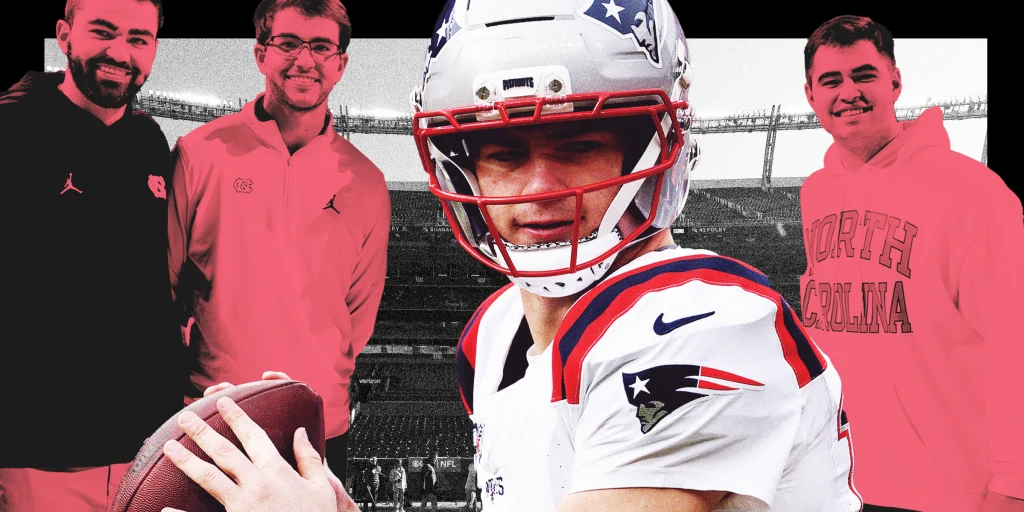
In the world of sports, certain families become legendary, known simply by their last names. The Mannings in football and the Williams sisters in tennis are prime examples. In North Carolina, the Maye family has built a similar reputation, producing four talented brothers who excelled in athletics within just over five years of each other.
Luke Maye, the eldest, carved his name into college basketball history at the University of North Carolina when he delivered the iconic shot that propelled the Tar Heels into the 2017 Final Four. Following him, Cole Maye achieved remarkable success in baseball, pitching for the University of Florida and helping secure the College World Series championship. The third brother, Beau, also showcased his basketball talent with the Tar Heels.
The Youngest Brother Who Refused to Be Overlooked
While his brothers stood tall—each measuring close to 6 feet 7 or 6 feet 8—Drake Maye, the youngest sibling, often saw himself as the underdog. He joked about being the “runt” of the family, frequently finding himself teased and challenged by his older brothers. Yet those experiences shaped him into a competitor.
Drake once recalled how intense their sibling rivalry could get, joking that his athletic ability often saved him from being overpowered. That relentless environment helped him develop both resilience and confidence—qualities that would later define his football career. Today, This Super Bowl quarterback credits his success to life as a little brother, a perspective that reflects how those early challenges forged his competitive edge.
Rising to NFL Stardom
Now just 23 years old, Drake has emerged as the starting quarterback for the New England Patriots. In only his second NFL season, he has already earned MVP finalist recognition and is preparing to lead his team into the Super Bowl against the Seattle Seahawks. A victory would make him the youngest quarterback ever to win the championship, a milestone that would further cement his meteoric rise.
Coaches and mentors frequently highlight Drake’s upbringing as a key ingredient in his development. His college coach, Mack Brown, believes growing up with three older brothers created the perfect environment for building leadership and toughness. He described Drake’s childhood as a constant competition, with backyard games serving as training grounds for his future success.
Similarly, Drake’s high school football coach, Scott Chadwick, emphasized that surviving and thriving in such a competitive household demanded extraordinary determination and grit.
The Science Behind Sibling Rivalry
Experts suggest that sibling competition is deeply rooted in human biology. According to researcher Frank J. Sulloway, rivalry among siblings is a natural evolutionary behavior driven by competition for parental attention and resources. He compares this to certain animal species, where younger offspring must adapt quickly to survive.
While human siblings obviously avoid extreme behaviors seen in nature, they still develop survival strategies through competition. Younger siblings often become more creative, competitive, and determined, traits that help them carve out their own identity.
For Drake, these survival skills were honed during intense pickup basketball games with his brothers. The matches were reportedly so physical that their father occasionally had to step in to restore order. Drake admitted that bragging rights were always on the line, fueling their determination to win at all costs.
Building Strength Through Adversity
Drake’s athletic versatility became evident during his time at Myers Park High School, where he played power forward in basketball despite frequently facing taller opponents. His aggressive playing style and ability to dominate rebounds set him apart. Coaches recalled how he used physicality and confidence to create scoring opportunities.
He also developed a reputation for his playful trash talk, a skill shared by all four brothers. One memorable incident involved a golf game where Drake repeatedly warned opponents about a water hazard—only for them to hit their shots directly into it, sparking laughter and frustration in equal measure.
Stepping Out of the Shadows
Despite his growing achievements, Drake initially lived in the shadow of his older brothers, especially Luke, whose basketball heroics brought national attention. At Drake’s high school football games, officials sometimes had to ask fans not to crowd Luke for autographs, highlighting the intense spotlight surrounding the family.
However, Drake soon began building his own legacy on the football field. Research suggests younger siblings often pursue high-risk sports to differentiate themselves, and Drake found his identity as a quarterback. His natural throwing ability impressed teammates and coaches alike, with his passes known for their accuracy and tight spirals.
During his junior year, Drake threw an incredible 50 touchdown passes while recording just two interceptions, establishing himself as one of the nation’s top prospects.
Choosing His Own Path
Highly sought after by top college football programs, Drake initially committed to Alabama, seeking championship opportunities similar to those achieved by his brothers. However, after careful consideration—and perhaps some family influence—he eventually chose to follow tradition and join the University of North Carolina.
At UNC, Drake strengthened family bonds by living with his brother Beau, further reinforcing the support system that had shaped him since childhood.
A Legacy in the Making
Drake Maye’s journey from the youngest sibling fighting for recognition to a Super Bowl quarterback demonstrates how early life challenges can create extraordinary athletes. His story proves that competition within families can build character, resilience, and determination.
As he prepares for football’s biggest stage, Drake continues to embody the lesson that shaped his life—This Super Bowl quarterback credits his success to life as a little brother—a reminder that sometimes the toughest beginnings create the strongest champions.