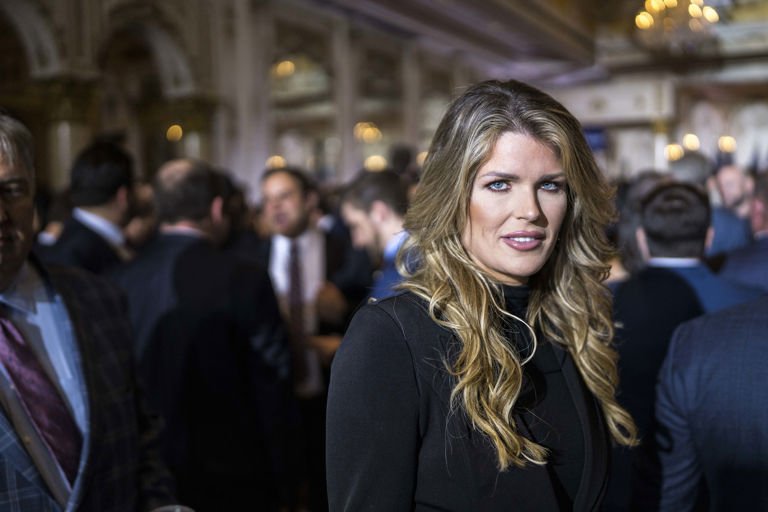
Lindsey Halligan, President Donald Trump’s handpicked interim U.S. attorney for the Eastern District of Virginia, abruptly left the Justice Department on Tuesday, bringing a controversial and turbulent chapter to a close. (Lindsey Halligan leaves the Justice Department hours after a Trump-appointed federal judge criticizes her leadership as a “charade.”) Her departure followed intense judicial criticism and months of legal disputes surrounding her authority to serve in the role.
Attorney General Pam Bondi confirmed Halligan’s exit in a post on X, describing her departure as “a significant loss” to the department. Bondi added that Halligan “will continue to serve her country in other ways,” though no details were provided about her next steps.
Judge Slams Halligan’s Conduct and Rhetoric
The timing of Halligan’s exit raised eyebrows, as it came just hours after U.S. District Judge David Novak issued a sharply worded ruling condemning her conduct. Novak, himself appointed by Trump in 2019, criticized Halligan for using what he described as “unnecessary rhetoric” in court filings. According to the judge, her tone carried “a level of vitriol more appropriate for a cable news talk show” than a federal courtroom.
Novak’s rebuke stemmed from Halligan’s insistence on continuing to identify herself as the U.S. attorney despite a prior ruling that found her appointment invalid. That earlier decision, issued in November by U.S. District Judge Cameron McGowan Currie, concluded that Halligan was unlawfully serving in the position—effectively derailing criminal cases she had brought against former FBI Director James Comey and New York Attorney General Letitia James, both political adversaries of President Trump.
Disputed Authority and Growing Judicial Frustration
Despite the November ruling, Halligan continued to use the title of U.S. attorney in court documents, a move that angered several judges in the district. Novak noted in an 18-page opinion that Halligan repeatedly identified herself as the district’s top federal prosecutor, even after being given the opportunity to justify her position.
After reviewing her response, Novak dismissed her arguments as unpersuasive. He also criticized the fact that her filing was supported by both the attorney general and deputy attorney general, stating that it fell “far beneath the level of advocacy expected” from the Department of Justice.
While Novak warned that Halligan—and anyone who joined her in using the improper title—could face disciplinary action, he ultimately stopped short of imposing sanctions. Citing her lack of prior prosecutorial experience when she assumed the role in September, he said he was giving her the benefit of the doubt.
Judges Move to Fill the Vacancy
As the controversy intensified, judges in the Eastern District of Virginia began taking steps to find a replacement. Chief Judge M. Hannah Lauck issued an order noting that Halligan’s 120-day term as interim U.S. attorney had expired on Tuesday—the same day she departed.
Under federal law, district judges are empowered to appoint an interim U.S. attorney when a vacancy exists and the Senate has not confirmed a nominee. Although Trump had formally nominated Halligan for the permanent role, the Senate never approved her appointment.

Lauck announced that the court would begin accepting applications for the interim position through February 10, directing the clerk’s office to circulate the vacancy widely among legal communities in the region.
Halligan Pushes Back in Farewell Statement
In a statement released Tuesday evening, Halligan acknowledged that her temporary appointment had ended but criticized the judges for failing to appoint a successor after the November ruling. She argued that their inaction created an institutional “vacuum,” leaving both the executive and judicial branches at odds over who had the authority to fill the role.
“The court took no action to fill the vacancy it said already existed,” Halligan said, defending her continued leadership of the office during the dispute.
Shortly before her departure was announced, the Justice Department instructed prosecutors in the district to refer to Halligan as a “special attorney” rather than U.S. attorney on court filings, according to a source familiar with the matter.
A Chaotic Tenure Comes to an End
Halligan’s exit marks the end of a brief but highly contentious tenure. She took over the office in Alexandria, Virginia, after her predecessor, Erik Siebert, left amid pressure to pursue politically sensitive cases. Halligan quickly moved forward with prosecutions that ultimately collapsed once her authority was challenged.
Judges in the district grew increasingly blunt in their assessments. Magistrate Judge William Fitzpatrick stated last month that Halligan “is not and has not been the United States Attorney.” Novak echoed that sentiment in his ruling, writing that Halligan’s actions amounted to open defiance of binding court orders.
“This charade of Ms. Halligan masquerading as the United States Attorney for this District must come to an end,” Novak declared.
With her departure now official, the Eastern District of Virginia is once again searching for stable leadership, hoping to put months of legal and political turmoil behind it.