President Donald Trump’s latest remarks suggesting that his newly proposed Board of Peace could one day replace the United Nations have intensified international unease. Diplomats and analysts fear that a body originally presented as a mechanism to oversee Gaza’s reconstruction may instead become a platform for challenging the global institution that has shaped international diplomacy for eight decades.
Those fears deepened after Trump openly criticized the UN during a White House briefing, reinforcing suspicions that the initiative is less about rebuilding Gaza and more about redefining global governance. Trump said a newly established Board of Peace to oversee Gaza’s reconstruction could potentially replace the United Nations, a statement that has alarmed allies and rivals alike.
Early Diplomatic Alarm and Structural Questions
Even before Trump’s comments, foreign officials had raised serious questions about the board’s design. Among the most controversial aspects is the option for countries to purchase a permanent seat for a reported $1 billion contribution. Critics argue that this pay-to-play model undermines the legitimacy of an organization meant to promote peace and stability.
The announcement comes as Trump travels to the World Economic Forum in Davos, Switzerland, amid growing frustration from NATO allies over his repeated assertions that the United States should acquire Greenland. For many diplomats, the timing adds to the perception that the Board of Peace is part of a broader effort to disrupt existing international frameworks.
Executive Board and Trump’s Indefinite Role
The White House has unveiled what it calls a “founding Executive Board,” featuring high-profile figures including Jared Kushner, Secretary of State Marco Rubio, special envoy Steve Witkoff, and former UK Prime Minister Tony Blair.
According to a draft charter obtained by CNN, Trump would serve as chairman of the board indefinitely — even beyond his current presidential term. His removal would only occur through voluntary resignation or unanimous agreement by the executive board due to incapacity. While future US presidents may appoint additional representatives, Trump’s continued leadership remains enshrined in the structure.
Invitations have reportedly been sent to dozens of countries, with a signing ceremony expected in Davos. However, participation remains uncertain.
Mixed International Response
While nations such as the United Arab Emirates and Bahrain have confirmed their involvement, others remain hesitant. France has formally declined, citing concerns that the board would duplicate — or compete with — the United Nations.
French officials emphasized that the board’s charter extends far beyond Gaza, raising questions about its compatibility with the UN Charter. Ireland has also expressed caution, noting that the proposed mandate exceeds the scope of any Gaza-specific peace initiative.
Russia, China, and Rising Controversy
Perhaps most contentious is the invitation extended to Russia, China, and Belarus. The inclusion of Russia, which is actively engaged in an ongoing war, has triggered sharp criticism.
Former US deputy ambassador to the UN Robert Wood warned that Moscow could use the board to weaken the UN and fracture Western alliances. British Foreign Secretary Yvette Cooper echoed that sentiment, stating bluntly that Russian President Vladimir Putin “does not belong in any organization with peace in its name.”
An Attempt to Undermine the UN?
The draft charter describes the Board of Peace as an international body aimed at restoring governance and securing long-term stability in conflict zones. Notably, it does not explicitly reference Gaza, fueling suspicions that its ambitions stretch far beyond reconstruction efforts.
Trump reinforced those suspicions by openly dismissing the UN’s effectiveness, claiming it had failed to resolve conflicts he believes his administration handled independently.
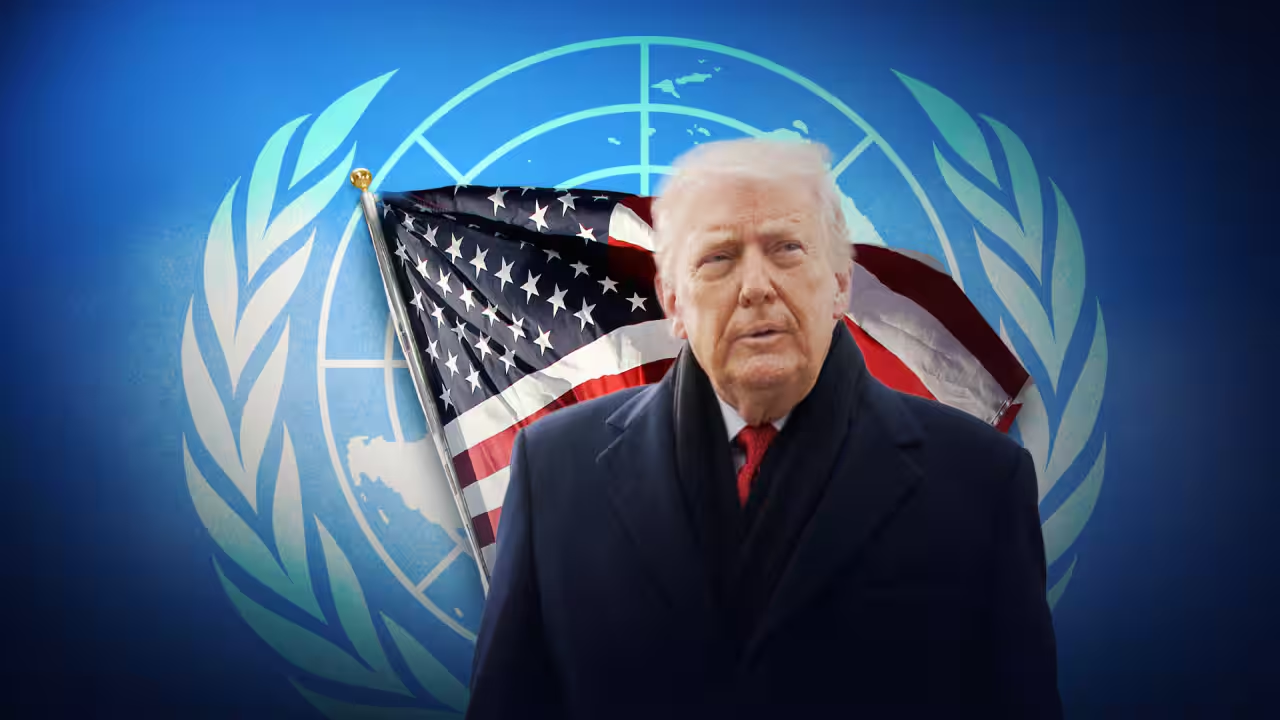
Despite these assertions, senior UN officials have pushed back. The organization’s top humanitarian official, Tom Fletcher, stated unequivocally that the Board of Peace will not replace the United Nations.
Experts Doubt Its Viability
Veteran US diplomat Aaron David Miller questioned the board’s practicality, arguing that peace is achieved through direct mediation between conflicting parties, not newly created external bodies. He emphasized that despite its flaws, the UN’s size, history, and legitimacy make it irreplaceable.
“You can’t rival an organization that has been central to global peacekeeping since 1946,” Miller said, noting the UN’s extensive humanitarian and diplomatic reach.
The $1 Billion Seat Controversy
Under the proposed structure, board members would serve three-year terms, with permanent seats requiring a $1 billion contribution. US officials insist the money would be directed toward Gaza’s reconstruction and is not a mandatory entry fee.
Still, diplomats remain skeptical. Several countries have acknowledged they would need extensive economic and parliamentary review before committing such funds. Critics argue that financial capacity does not equate to moral or diplomatic authority.
Miller likened the arrangement to an exclusive private club, questioning how democratic governments could justify both the financial cost and the surrender of influence to Trump’s veto power.
Uncertain Future
Despite widespread skepticism, interest in the board is growing behind the scenes. Some nations not initially invited are reportedly exploring ways to join, including the possibility of paying the steep fee.
Whether the Board of Peace becomes a meaningful force or fades amid international resistance may ultimately depend on what, if anything, it accomplishes in Gaza. For now, however, many world leaders see it less as a path to peace and more as a challenge to the global order built around the United Nations.