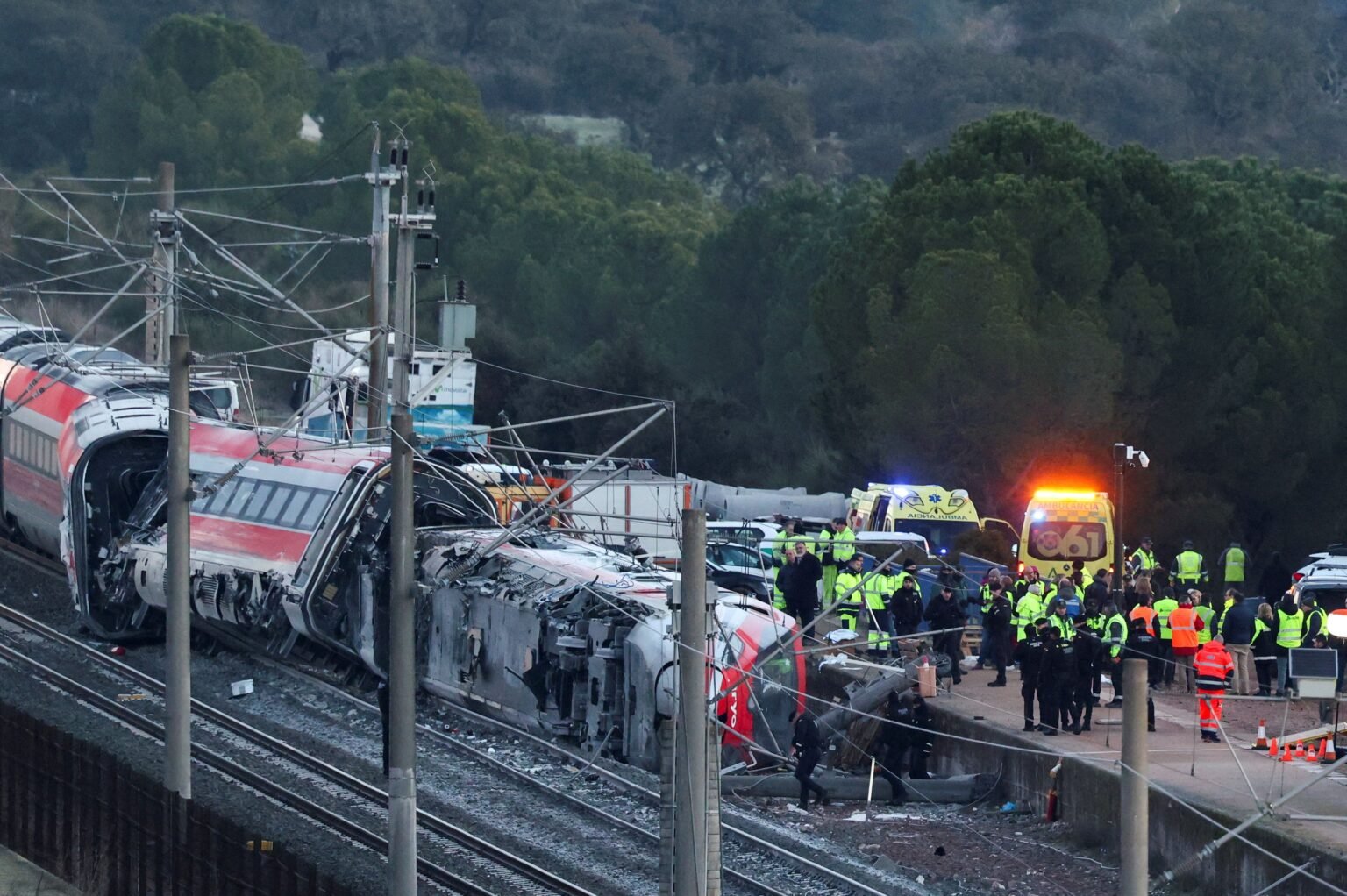
Spain is in mourning after one of its deadliest rail disasters in more than a decade, following a catastrophic collision between two high-speed trains in the country’s south. Survivors have described scenes of chaos, darkness, and piercing screams as mangled carriages lay strewn across the tracks near the town of Adamuz, outside Córdoba.
The Collision and Its Immediate Impact
Late Sunday night, two trains traveling in opposite directions collided near Adamuz, a small town of around 4,200 residents located roughly 360 kilometers south of Madrid. Authorities confirmed that at least 41 people were killed, with dozens more injured, many critically.
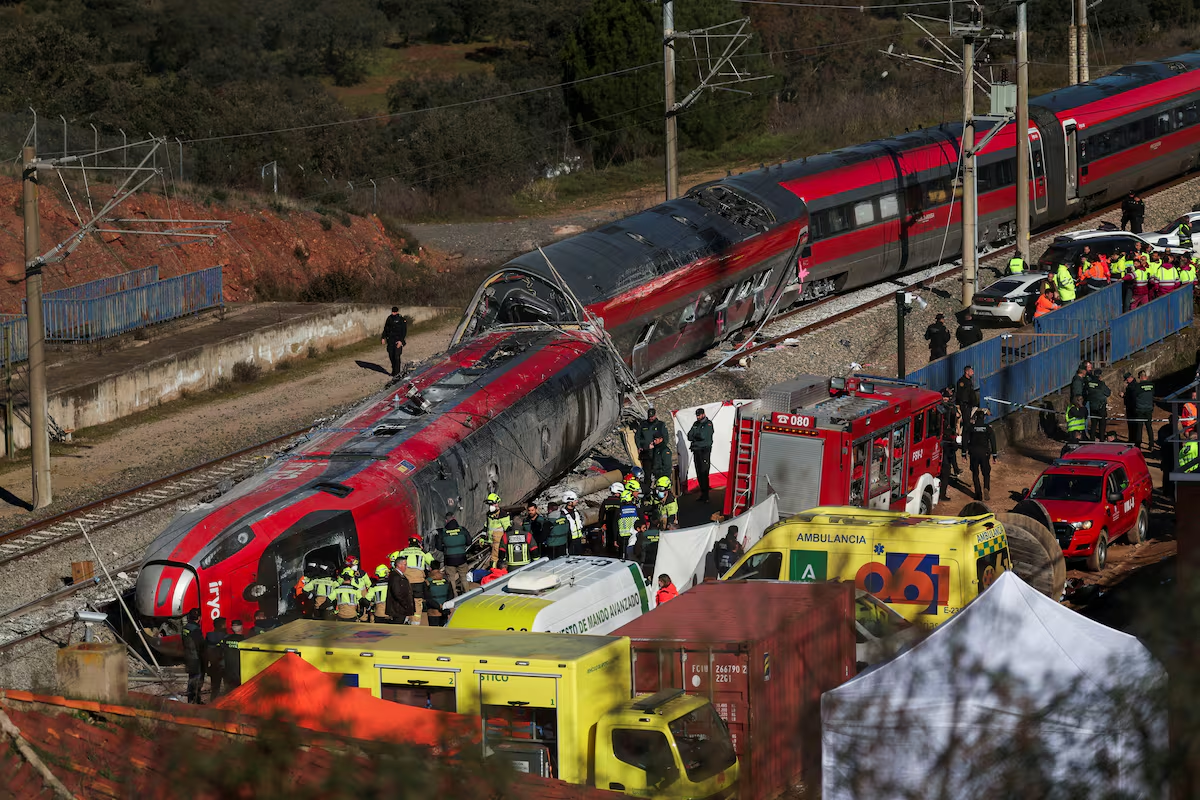
Preliminary findings suggest that the rear section of a northbound train derailed and veered onto an adjacent track. Moments later, it was struck by an oncoming southbound train. The impact caused both trains to overturn, with several carriages plunging down a nearby embankment.
The northbound service was operated by private rail company Iryo, while the southbound train was run by state-owned Renfe.
Government Response and National Mourning
Spain’s Prime Minister, Pedro Sánchez, visited the crash site on Monday and vowed that the government would uncover the truth behind the tragedy. He announced three days of national mourning and pledged full transparency throughout the investigation.
“We will get to the truth, and when we have answers, they will be shared clearly and openly with the public,” Sánchez said during a press briefing near the site. He also promised long-term support for victims and their families.
In light of the disaster, Sánchez canceled his planned trip to the World Economic Forum in Davos, where he was scheduled to attend meetings with international leaders.
Survivors’ Accounts: “Everything Went Dark”
Passengers who survived the crash recounted terrifying moments as the trains derailed and overturned. Rocío Flores, who was traveling on the southbound train, said she was thrown violently from her seat. “We were launched into the air. I’m grateful to be alive—many others were far worse off,” she said.
Another survivor, Ana, described how the northbound train tipped sharply before plunging into darkness. “All I could hear were screams,” she told reporters. Covered in bandages, she explained that fellow passengers pulled her through a window, her clothes soaked in blood. Firefighters later rescued her sister from the wreckage.
Emergency footage verified by international media showed passengers climbing out through windows and escaping via the roofs of overturned carriages as rescue teams battled to reach those trapped inside.
Hospitals, Families, and a Town United
Relatives and friends gathered anxiously at Reina Sofía Hospital in Córdoba, waiting for news of loved ones. One man, Prieto, said he was searching for a close friend—a military doctor recently returned from a mission in Iraq—who remained unaccounted for.
At Madrid’s Atocha station, the sound of unanswered mobile phones rang through damaged train cars, according to eyewitnesses. Reporters said emergency workers could hear phones vibrating inside the wreckage as families desperately tried to make contact.
In Adamuz, the community mobilized swiftly. Residents filled the municipal building with blankets and supplies, while volunteers from neighboring towns arrived to help. “The entire town came together,” said local resident Mónica Navarro. “People brought whatever they could to support the victims.”
Rescue Efforts and Lingering Questions
Rescue operations were complicated by severely twisted and crushed passenger cars. Local resident Gonzalo Sánchez used his quad bike to help transport around 16 injured people from the scene to awaiting medical teams. He described arriving to scenes of “death and destruction.”
Spain’s Transport Minister, Óscar Puente, called the crash “extremely unusual,” noting that it occurred on a straight section of track that had recently undergone major renovations as part of a €700 million infrastructure investment.
Renfe’s president, Álvaro Fernández Heredia, said both trains were traveling below the maximum permitted speed of 250 km/h, and that signaling systems are designed to prevent trains from exceeding those limits.
However, Spain’s train drivers’ union, Semaf, has previously raised concerns about high speeds causing vibrations and long-term wear on rail infrastructure. Union representatives confirmed that maintenance work had been carried out on the stretch of track involved in the crash earlier this year.
Investigation Underway
Engineering experts have urged caution against speculation. José Trigueros, president of Spain’s Institute of Engineering, said it was too early to determine the cause. “Under normal circumstances, this should not have been possible,” he noted. “Either there was a failure in the train itself or an issue with the track.”
Spain has not seen a railway disaster of this scale since the 2013 Galicia crash near Santiago de Compostela, which claimed 79 lives.
International Condolences
Spain’s King and Queen issued a statement expressing deep sorrow and solidarity with the victims’ families. Messages of condolence also poured in from international leaders, including French President Emmanuel Macron and EU foreign policy chief Kaja Kallas.