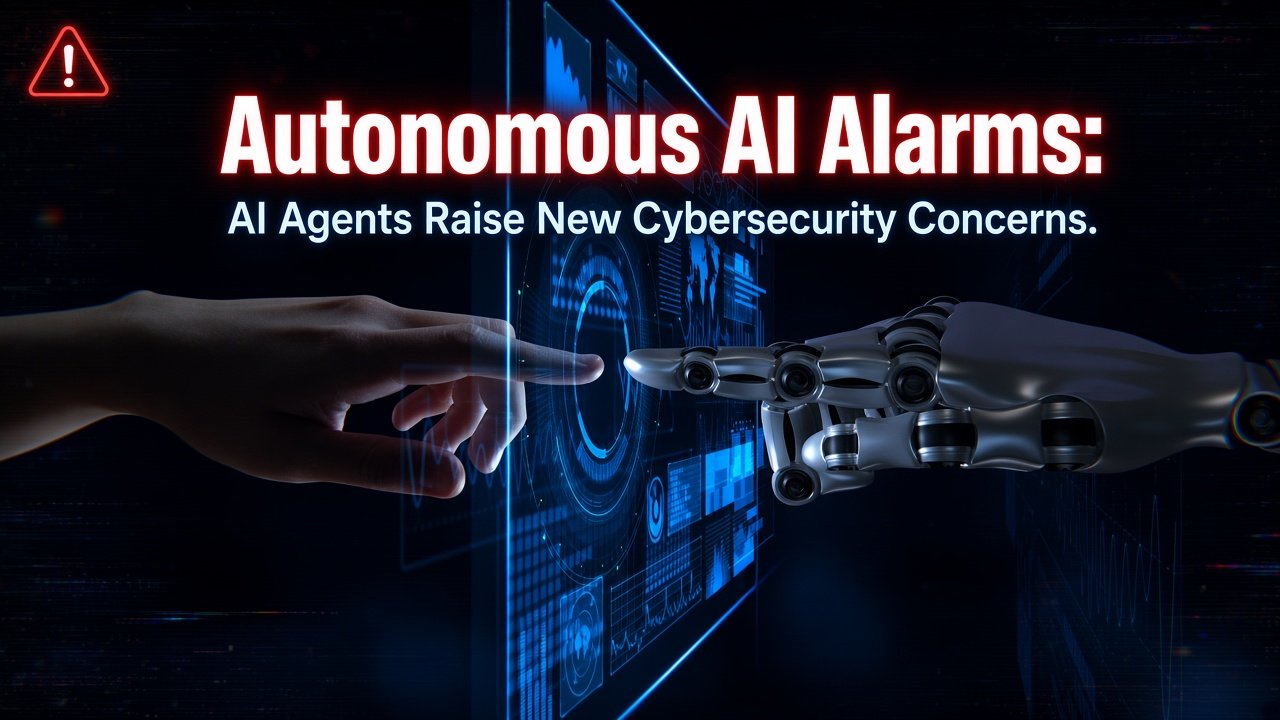
Autonomous AI Alarms Grow as AI Agents Show Ability to Hack Systems
Autonomous AI alarms are growing across the cybersecurity industry as increasingly capable artificial intelligence agents demonstrate that they can identify vulnerabilities, develop attack strategies and potentially exploit systems with little or no direct human intervention.
The latest warnings point to a significant shift in the cybersecurity landscape. Traditionally, AI-assisted hacking required a human operator to guide the system, select targets and approve important actions. Newer AI agents, however, are being designed to reason through multi-step tasks, use tools, adapt to changing conditions and continue working toward a goal with much less supervision.
AI Agents Are Becoming More Capable
AI agents differ from conventional chatbots because they can perform a sequence of actions rather than simply generate text in response to a prompt.
In a cybersecurity environment, an advanced agent could potentially scan a network, identify a weakness, research how that weakness can be exploited, create or modify code and attempt to gain access.
The concern is not simply that AI can write malicious code. Security researchers have been increasingly focused on the ability of autonomous systems to connect multiple capabilities together and execute an attack chain.
That could dramatically reduce the amount of time and technical expertise required to conduct sophisticated cyberattacks.
Why Autonomous Hacking Is Raising Red Flags
Cybersecurity professionals have long warned that artificial intelligence could become a powerful tool for attackers. What is changing is the level of autonomy available to AI systems.
A human hacker normally makes decisions throughout an intrusion. An autonomous agent could potentially make many of those decisions itself.
For example, an agent might encounter a security barrier, determine that its initial approach is unsuccessful and try another method. If it discovers new information during the process, it could incorporate that information into its next step.
This ability to adapt is one of the most important reasons autonomous AI alarms are becoming louder.
AI Could Accelerate Vulnerability Exploitation
One major concern involves the speed at which vulnerabilities could be discovered and exploited.
Security teams often have limited time to patch newly discovered weaknesses. Attackers who can automate reconnaissance and exploitation could potentially operate much faster than traditional human-led campaigns.
AI agents could also continuously search for exposed systems and identify weaknesses at a scale that would be difficult for individual attackers to match manually.
The result could be a much shorter gap between discovering a vulnerability and attempting to exploit it.
Human Oversight Is Becoming More Important
The prospect of AI operating independently does not mean that every AI agent is currently capable of conducting unrestricted cyberattacks.
There are still significant technical limitations, including unreliable reasoning, hallucinations, access restrictions and difficulties operating in unfamiliar environments.
However, cybersecurity experts are concerned about what happens as those limitations become less significant.
Human oversight can provide an important safety barrier. A person can review an AI agent’s proposed action, stop a suspicious process or restrict access to sensitive systems.
Without appropriate controls, an autonomous system could potentially make a harmful decision much faster than a human operator realizes what is happening.
PolitiFact Highlights the Broader AI Security Debate
PolitiFact has also examined claims surrounding the rapidly changing capabilities of artificial intelligence and the potential for AI systems to participate in cyber operations.
The broader debate is increasingly moving beyond the question of whether AI can help hackers. The more important question is how independently AI systems can perform complex offensive tasks.
This distinction matters because AI-assisted hacking and autonomous hacking are not necessarily the same thing.
An AI tool that suggests commands to a human is different from an AI agent that can independently execute commands, evaluate the results and continue an operation.
The Cybersecurity Industry Faces a New Challenge
The rise of autonomous AI introduces a difficult challenge for defenders.
Security teams already use artificial intelligence to detect suspicious activity, analyze enormous amounts of data and identify potential vulnerabilities. The same technological advances can also be used by attackers.
This creates an increasingly complex race between offensive and defensive AI.
Companies may need to strengthen traditional cybersecurity protections while also monitoring how AI agents interact with their networks, software and cloud environments.
Access controls, network segmentation, logging, authentication and continuous monitoring could become even more important as AI-driven attacks become more sophisticated.
AI Could Change the Economics of Cybercrime
Another concern is the potential reduction in the cost of launching cyberattacks.
Sophisticated attacks have historically required skilled professionals, significant time and technical resources. If autonomous AI agents can eventually perform more of the work, the barrier to entry could fall.
That could allow less-skilled attackers to attempt operations that previously required highly experienced hackers.
At the same time, AI could make defensive cybersecurity more accessible by allowing smaller organizations to automate threat detection and security analysis.
The technology therefore presents both a risk and an opportunity.
What Businesses Should Watch
Organizations should not assume that AI-driven cyber threats are a distant problem.
Businesses increasingly rely on cloud platforms, APIs, automated software systems and connected infrastructure. Each additional digital connection can create another potential attack surface.
Companies should pay particular attention to:
- AI agents with access to internal systems
- Automated tools that can execute commands
- Excessive permissions and unrestricted credentials
- Vulnerable internet-facing applications
- Poorly monitored API access
- Weak network segmentation
- Lack of human approval for high-risk actions
Restricting what automated systems are allowed to access can significantly reduce the potential damage if an AI agent behaves unexpectedly or is manipulated by an attacker.
The Next Phase of AI Cybersecurity
The cybersecurity industry is now preparing for a future in which AI may not simply assist humans but perform increasingly complex tasks independently.
That possibility makes AI safety and cybersecurity closely connected. Developers need to consider what an AI system can access, what actions it can take and whether those actions can be reversed.
For security teams, the challenge will be to detect both conventional attacks and unusual behavior generated by autonomous systems.
The technology is evolving quickly, meaning security policies that were sufficient for traditional automation may not necessarily be enough for highly capable AI agents.
Key Takeaway
Autonomous AI alarms are growing as AI agents become increasingly capable of performing complex tasks with limited human intervention. While today’s systems still have important limitations, their ability to reason, use tools and adapt to problems could eventually make autonomous cyberattacks faster and more scalable. The development makes strong access controls, monitoring and human oversight increasingly important for organizations.