


A poem written hundreds of years ago can still touch a reader who lives in a different country, speaks another language, and belongs to a different generation. But carrying the meaning of that poem into another language is far from simple.
For Dr. Shadab Ahmed, a celebrated author, translator, columnist, administrator and Maxillofacial Surgeon – this is what makes poetry translation such a demanding form of literary work. With years of reading and studying poetry from different inter-continental parts of the world, Dr. Ahmed has built a body of works that brings bygone literary traditions closer to his English-speaking readers in a kaleidoscope of intricate verbal construction marked in a rich tapestry of sophisticated lexical play.
On one hand, when his historical translated books like Songs of The Rajputana, The Despicable Musalman, Bebakhshid, Befarmaid & Randy’O Dandy command authority through their scrupulous fidelity to fact, woven into a resounding tapestry of verse and prose, his poetry and translations in La Siesta, Distilled Musings & Dead Man’s Heart inhabit an altogether more aristocratic realm, where intricate wordplay, Victorian refinement, and Persian-inspired imagery converge to create a language which appears viscerally ornate, cerebral, and deeply evocative.
Why Poetry Is Difficult to Translate
Translating a regular passage is often about carrying information from one language to another. Poetry asks for much more. A poet may use a single word to express an emotion, refer to a cultural custom, or suggest an idea that readers from the original culture would understand at once. When that word is translated directly, its deeper meaning may disappear.
A poem may also depend on rhythm, tone, word choice, and the way its lines are arranged. A translation that keeps the basic meaning may still fail to create the same feeling as the original. For Dr. Ahmed, this makes literary translation a careful process of understanding what the poet wanted to express and finding words that can carry that thought into another language.
Reading the World Behind the Words
Every literary work comes from a particular time, place, and way of life. Persian poetry, Indian verse, Turkish literature, and Spanish poetry each carry their own history, customs, and forms of expression. A reader who knows the original culture may understand references that are less familiar to a reader in another country. This is one reason Dr. Ahmed’s wide reading matters to his work.
His literary interests span Persian, Indian, Turkish, European, Mandarin, Hebrew, Russian, and Iberian traditions. Years of study have given him a broad view of how different societies have expressed their thoughts and emotions through poetry. For him, translating a poem calls for an understanding of the world behind it, rather than a simple change of language.
Translating What the Poet Felt
A poem about love, grief, faith, or longing may carry a feeling that is difficult to express in another language. Some expressions have no direct match. Others may sound natural in the original language but awkward when translated word for word.
Thus, the translator must make choices. Staying too close to the original wording may weaken the poem, while changing too much may move it away from the poet’s thought. This balance is a key part of Dr. Ahmed’s literary work. His approach reflects the belief that a translation should retain the meaning and emotional depth of the original while remaining readable for a new audience.
What We Still Share With Poets of the Past
Many of the feelings found in old poems remain familiar to people living centuries later.
Love, hope, loss, faith, sorrow, and longing have been part of human life across different periods and societies. The words may change, but the emotions behind them often remain close to our own experiences. This is one reason Dr. Ahmed continues to read and study classical poetry.
He believes that older works can still speak to modern readers when they are presented in a language they understand. Translation gives these readers a chance to form their own understanding of poets whose works may have been written hundreds of years ago.
A Surgeon with a Lifelong Love for Poetry
Alongside his work as an Administrator and Maxillofacial Surgeon, Dr. Ahmed has continued to spend time reading, researching, translating, and writing. His interest in poetry began during his teenage years and grew into years of literary study and published work.
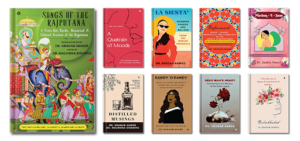
One of his recent and best-selling book, Songs of the Rajputana, reflects another part of his interests. Drawing from bardic traditions, historical records, military accounts, and colonial-era sources, the book presents accounts of Rajput history across different periods in a completely different light. While its subject differs from his translation work, it reflects his lasting interest in older texts, literature, and history.
Giving a Poem Another Life in English
The translation of a poem demands far more than the transposition of words from one language into another; it requires the crossing of an intricate intellectual and emotional frontier, where the translator must preserve the original thought, temperament, imagery, cadence, and subterranean meanings, while recasting them with sufficient grace and fidelity that the poem may enter a new linguistic world without surrendering the spirit that first gave it life.
For Dr. Shadab Ahmed, this is what makes literary translation a serious and rewarding form of work. Through his books and years of study, he continues to bring poetry from different literary traditions to English-speaking readers, giving them access to works they may never have read in their original languages. His work reflects a simple belief: great poetry deserves to be read beyond the boundaries of the language in which it was first written.