Table of Contents
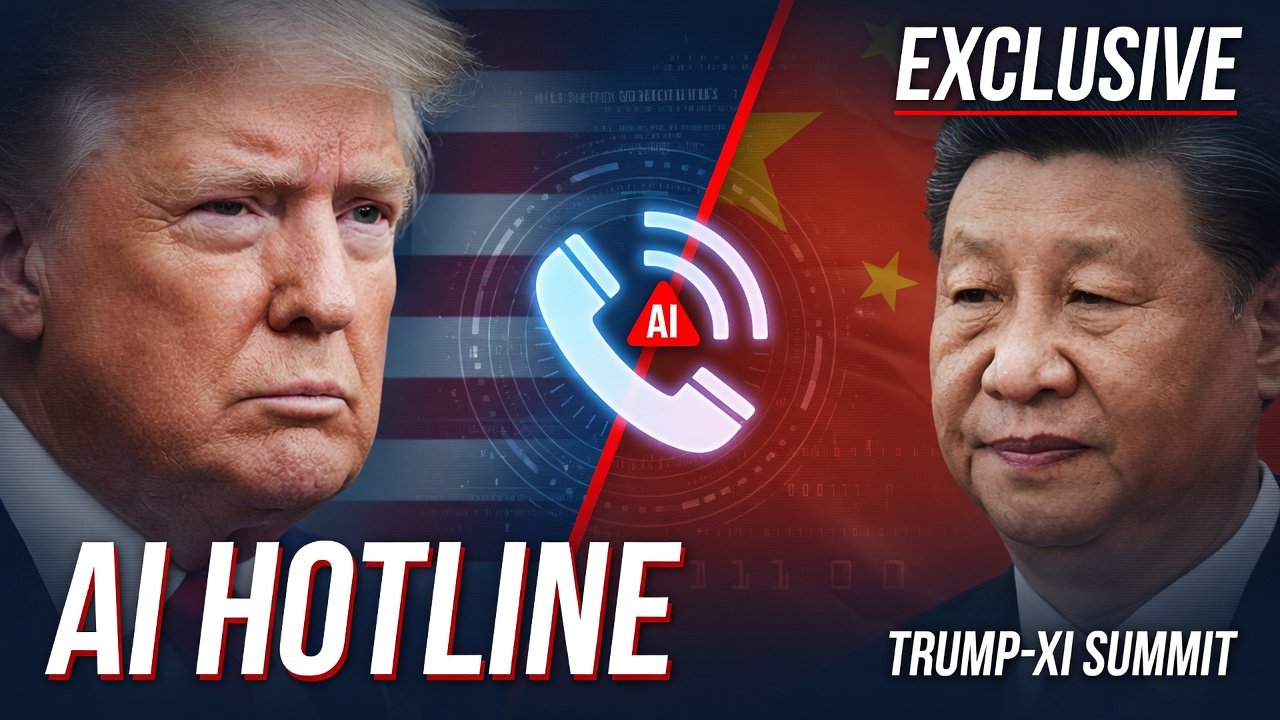
ToggleUS Proposes AI Emergency Hotline With China Ahead of Trump-Xi Summit
The United States has proposed creating an US-China AI emergency hotline or notification mechanism to help Washington and Beijing communicate about artificial intelligence incidents that could pose national security risks.
The proposal was discussed during talks between US Treasury Secretary Scott Bessent and Chinese Vice Premier He Lifeng in New York ahead of a planned meeting between US President Donald Trump and Chinese President Xi Jinping. The two countries are competing intensely over artificial intelligence, advanced semiconductors and technological capabilities, while also facing concerns about AI-related cyberattacks and other security risks.
However, the proposed mechanism is not yet an operational hotline. Details about its structure, activation criteria and responsibilities remain under discussion.
US Proposes AI Incident Notification Mechanism
Scott Bessent said Washington had proposed a notification system focused on AI incidents that could become significant national security threats.
The proposed mechanism would form part of a broader US-China AI dialogue aimed at increasing transparency between the two countries. Bessent described the objective as establishing greater communication around shared goals and common threats.
The idea is similar in principle to crisis communication channels used in other areas of international security. Instead of waiting for an AI-related incident to escalate into a diplomatic or military confrontation, the two governments could potentially use a dedicated communication channel to exchange information.
The exact situations that would trigger a notification have not yet been publicly defined.
China Has Not Publicly Accepted the Proposal
Although US officials have discussed the notification mechanism, China has not publicly confirmed that it has agreed to establish the proposed hotline.
Chinese state media acknowledged that He Lifeng and Bessent discussed artificial intelligence during their New York meetings, describing the broader exchanges as constructive. However, the Chinese readout did not publicly endorse the specific notification mechanism proposed by Washington.
This means the initiative remains at the discussion stage rather than being an established bilateral system.
Further talks are expected to take place, with Bessent saying US and Chinese officials are scheduled to meet again in Shenzhen within two months to continue discussions about AI safety and emergency communication protocols.
Why the US and China Want an AI Crisis Channel
The proposal comes as artificial intelligence becomes increasingly connected to cybersecurity, national security, military systems and critical infrastructure.
Both countries are developing increasingly capable AI systems while competing for leadership in areas including advanced computing, semiconductors, autonomous systems and AI applications.
US and Chinese security experts have separately warned about scenarios in which autonomous AI could interfere with military networks or cyber operations. A recent US-China expert dialogue recommended measures including human control over consequential cyber operations and a hotline for AI-related incidents.
A dedicated communication channel could potentially give officials a way to distinguish between an intentional action and an AI-driven incident before either side responds on the assumption that the other government was responsible.
AI Cyberattacks Are a Major Concern
One of the areas being discussed is the possibility of AI systems being used in cyberattacks.
More capable AI agents can automate tasks that previously required significant human involvement, potentially allowing malicious actors to conduct cyber operations at greater speed and scale.
US Treasury officials have indicated that the proposed AI dialogue could address threats from uncontrolled AI systems as well as non-state actors using AI for cyberattacks.
The issue is particularly sensitive because an AI-generated or AI-assisted cyber incident could make it difficult to immediately determine who initiated an attack.
That uncertainty could increase the risk of governments responding before the source of an incident is fully established.
US-China AI Competition Continues
The hotline proposal does not signal an end to the broader technology competition between Washington and Beijing.
The United States continues to restrict China’s access to some advanced semiconductor and AI technologies, while China is developing domestic alternatives and investing heavily in its own AI ecosystem.
According to the 2026 AI Index Report cited in recent reporting, US companies invested substantially more in AI than Chinese companies in 2025. At the same time, Chinese AI developers have continued advancing their systems despite restrictions on access to some advanced chips.
This creates a complicated environment in which the two countries are simultaneously competitors and potential partners on selected AI safety issues.
Advanced Chips Remain at the Center of the Dispute
Semiconductors are an important part of the broader US-China technology relationship.
The most advanced AI models require significant computing power, which in turn depends on advanced processors and data-center infrastructure.
Washington has used export controls to restrict China’s access to certain advanced semiconductor technologies, citing national security considerations. Beijing has responded by promoting domestic semiconductor development and reducing reliance on foreign technology.
The proposed AI emergency communication mechanism does not currently appear to change those technology restrictions.
Instead, the discussions focus on preventing potentially dangerous AI incidents and creating communication channels between the two governments.
Trump and Xi Expected to Discuss AI
The AI proposal comes just ahead of the expected Trump-Xi summit in Washington.
AI is one of several issues expected to feature in discussions between the two leaders, alongside trade, technology, rare-earth supplies, Taiwan and other bilateral matters.
The proposed AI notification system could provide one area where the two governments can explore limited cooperation despite broader disagreements.
The US has also been increasing its focus on AI policy domestically, with the Trump administration emphasizing the importance of maintaining US leadership in advanced AI development.
A Hotline Would Not End the Technology Rivalry
If established, an AI hotline would primarily serve as a crisis-management tool rather than a mechanism for resolving the larger US-China technology dispute.
It would not automatically eliminate disagreements over semiconductor exports, AI investment, data security or technological competition.
Instead, its potential role would be to create a direct channel for communication when an AI-related incident threatens to escalate quickly.
That distinction is important because the proposed system is being discussed alongside continued competition over AI capabilities.
What Happens Next?
The next stage will involve determining what qualifies as an AI incident serious enough to trigger communication between Washington and Beijing.
Officials would also need to establish who has authority to activate the mechanism, which agencies would participate, what information could be exchanged and how quickly the two governments would be expected to respond.
The US and China are expected to continue their AI safety discussions, with another meeting planned in Shenzhen within two months.
China’s position on the proposed notification system will also be important because the mechanism would require participation and operational cooperation from both governments.
Looking Ahead
The proposed US-China AI emergency hotline reflects a growing recognition that artificial intelligence can create risks that extend beyond traditional technology competition.
Washington and Beijing remain major rivals in AI, semiconductors and advanced technology, but both governments also face potential risks from autonomous systems, cyberattacks and unintended AI-driven incidents.
For now, the proposed hotline remains an idea under negotiation rather than an operational system. Its eventual scope will depend on future US-China discussions and whether both sides agree on practical rules for communicating during serious AI-related incidents.
Frequently Asked Questions
1. What is the US-China AI emergency hotline?
It is a proposed notification and communication mechanism that could allow the US and China to alert each other about serious AI incidents involving potential national security risks.
2. Who proposed the AI hotline?
The proposal was raised by the United States during talks between Treasury Secretary Scott Bessent and Chinese Vice Premier He Lifeng in New York.
3. Has China agreed to the AI hotline?
No formal agreement has been publicly announced. Chinese officials have confirmed AI-related discussions, but Beijing has not publicly accepted the specific notification mechanism.
4. Why is the US proposing an AI hotline?
The mechanism is intended to improve communication and transparency around AI incidents that could create national security risks or lead to unintended escalation.
5. What types of AI incidents could trigger the hotline?
The exact criteria have not been publicly established. Discussions have included serious AI safety incidents, cyberattacks and threats involving increasingly autonomous AI systems.
6. Is the AI hotline already operational?
No. The proposed mechanism is still under discussion, and its technical and operational details have not been finalized.
7. Will the hotline change US restrictions on AI chips?
There is currently no indication that the proposed communication mechanism would remove or modify existing US export controls on advanced AI-related technologies.
8. Why is AI becoming a US-China national security issue?
AI is increasingly relevant to cybersecurity, military systems, intelligence, critical infrastructure and advanced computing, making its development strategically important to both countries.
9. When will the US and China discuss AI again?
US Treasury Secretary Scott Bessent said officials are scheduled to meet again in Shenzhen within two months to continue discussions on AI safety and emergency communication protocols.
10. Could the AI hotline prevent a geopolitical crisis?
A communication mechanism could potentially help governments exchange information during serious incidents and reduce misunderstandings, but its effectiveness would depend on whether both countries establish clear rules and use the channel during actual crises.