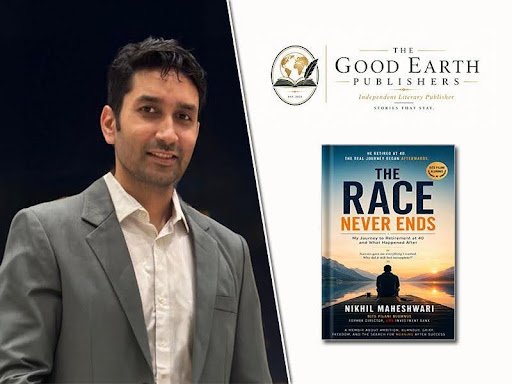
A book is never the beginning of a writer’s story. Long before the book reaches a reader’s hands, it has already lived through years of doubt, conviction, solitude, and quiet persistence. Yet those unseen years rarely find a place in the conversation. There is a writer whose story remains untold.
At The Good Earth Publishers, we believe he should.
Through the Complimentary Author Visibility Programme, The Good Earth Publishers introduces debut authors while their manuscripts are still under editorial review, inviting readers into the conversations that shape a book long before publication.
Our inaugural conversation is with Nikhil Maheshwari, whose debut memoir, The Race Never Ends, is expected to be released soon in print and digital editions. In this conversation, he reflects on success, purpose, memory, writing, and the quiet questions that eventually became a book.
TGEP: Your memoir opens with a striking line: “I retired at 40 and discovered that freedom is far more complicated than a number.” Most people would see retiring at forty as the end of a dream. Why did it become the beginning of your story?
Nikhil Maheshwari: Retiring early solved a financial problem, but it did not answer the questions I had been carrying for years. I realised that freedom isn’t something you arrive at through numbers alone. Once work no longer defined my days, I had to confront a more difficult question, who was I without the next goal to chase? That question became the real beginning of the memoir.
TGEP: You grew up in a middle-class family in Ajmer. How much of that childhood still lives within the person you are today?
Nikhil Maheshwari: Almost all of it. My childhood taught me that security had to be earned and that education was the surest path to a better life. Those values gave me discipline and purpose, but they also shaped the way I measured success for many years. Writing this memoir helped me see that while those lessons built my career, they didn’t have to define my entire life.
TGEP: You write that many middle-class children inherit a formula, study hard, build a career, earn well, and everything else will fall into place. When did you begin to question that formula?
Nikhil Maheshwari: Not after one event, but after many years of living it. Every milestone brought satisfaction, but only briefly. There was always another target waiting. Gradually I realised that I had become very good at achieving and very poor at pausing. That was when I began asking whether I was living intentionally or simply following a script I had inherited.
TGEP: The book speaks with unusual honesty about grief. Did writing those chapters change your relationship with loss?
Nikhil Maheshwari: Yes. Grief never disappears, but writing gave it language. Some experiences remain buried until you find the courage to revisit them. Putting those memories on paper didn’t erase the pain, but it helped me understand how profoundly they had shaped my choices, my priorities, and the person I was becoming.
TGEP: You spent years analysing markets and managing risk. Did the analytical mind ever come into conflict with the emotional honesty memoir demands?
Nikhil Maheshwari: Quite often. My professional life trained me to value certainty, evidence, and logic. Memoir asks for something different. It asks you to acknowledge ambiguity, vulnerability, and emotions that cannot always be explained. In many ways, writing the book taught me that not everything meaningful can be measured.
TGEP: Your dedication to Kanika, Aahana and Naysha is deeply moving. Was your family always present in your mind while writing?
Nikhil Maheshwari: Absolutely. This book would not exist without them. My family gave me both the happiest moments of my life and the experiences that changed me most deeply. Every chapter carries something of them, whether directly or indirectly. They are not simply part of my story, they are the reason I understand life differently today.
TGEP: After reading the memoir, what do you hope readers understand about success that they perhaps didn’t before?
Nikhil Maheshwari: That success and fulfilment are not the same thing. Achievement has its place, and I remain grateful for everything my career gave me. But if we allow external milestones alone to define our worth, we risk postponing the life we are trying so hard to build. I hope readers feel encouraged to define success for themselves, rather than inherit someone else’s definition.
The Complimentary Author Visibility Programme is an editorial initiative of The Good Earth Publishers dedicated to introducing promising writers before publication. Each conversation explores the experiences, ideas, and inspirations behind an upcoming book, offering readers an opportunity to meet the author before meeting the work. This interview with Nikhil Maheshwari is the first in an ongoing series featuring writers whose manuscripts are currently under editorial review. Readers can learn more about The Good Earth Conversations, and other editorial initiatives by visiting www.thegoodearthpublishers.com