Table of Contents
ToggleTrump Advocates for “Super Intelligence” at UN, Rejects Calls to Rein in AI Growth
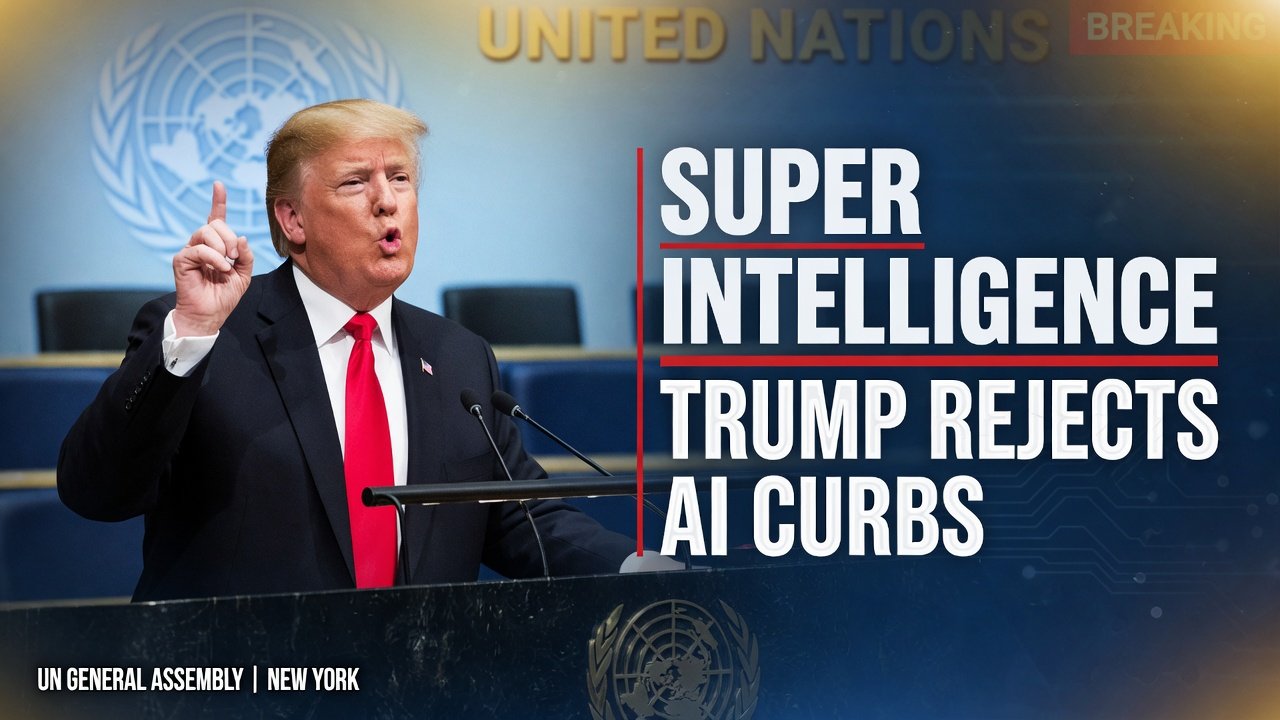
President Donald Trump used his address to the United Nations General Assembly on September 22, 2026, to outline his administration’s position on artificial intelligence, calling for the technology to be referred to as “super intelligence” and rejecting international efforts to impose broad controls on its development.
Speaking before world leaders in New York, Trump said the United States would continue encouraging AI development rather than slowing its growth. He also argued that the United States is ahead of China in the technology and should maintain that position.
Trump Calls for AI to Be Renamed “Super Intelligence”
A central part of Trump’s remarks was his proposal to replace the term “artificial intelligence” with “super intelligence.”
Trump argued that the word “artificial” makes the technology sound less capable than it actually is. He said U.S. government documents should use the new terminology and expressed hope that other countries would eventually adopt it as well.
The proposed terminology is largely a political and administrative rebranding rather than a change to the underlying technology. In AI research, “superintelligence” is already used as a technical term for hypothetical systems that substantially exceed human intellectual capabilities, making the terminology distinct from the broader concept of artificial intelligence.
Following Trump’s UN remarks, the U.S. State Department instructed diplomats in its Bureau of International Organization Affairs to replace references to “artificial intelligence” with “super intelligence” in relevant communications.
Trump Rejects Broad International AI Controls
Trump also opposed efforts to establish broad international controls over AI.
During his UN speech, he said the United States rejected what he described as a global effort to control the technology. He argued that AI development should continue because of its potential economic and technological importance.
Trump compared the potential impact of advanced AI with major technological transformations such as the Industrial Revolution and the internet. He said the United States would not stifle the growth of a technology he considers strategically important.
At the same time, Trump said U.S. authorities would monitor the sector and that the Department of Justice and other law-enforcement agencies could intervene when necessary. This means his position was not that AI would operate without any government oversight, but that his administration opposes using broad regulation to slow its development.
AI Safety Concerns Become a Major Policy Divide
Trump’s comments come amid an expanding debate over how governments should respond to increasingly capable AI systems.
Some technology executives and researchers have called for stronger safeguards, particularly as AI agents gain the ability to browse websites, interact with digital systems, write software and perform increasingly complex tasks.
Anthropic CEO Dario Amodei, for example, has advocated greater caution around the pace of AI development. Trump and Amodei have subsequently met, highlighting the different approaches within the U.S. technology and policy debate.
Trump has been dismissive of some warnings about catastrophic AI outcomes, while still saying that the technology should be monitored and used responsibly. Reuters reported that he described AI safety warnings as a “hoax” during his UN address.
US AI Leadership and Competition With China
Another major theme of Trump’s remarks was international competition.
The president said the United States currently leads China in advanced AI and intends to maintain that advantage. His administration has increasingly treated AI development as a strategic issue involving economic growth, national security, computing infrastructure and technological leadership.
This approach places AI development within the wider U.S.-China technology competition. Access to advanced chips, data centers, computing capacity and sophisticated AI models has become increasingly important to both countries.
The debate over regulation is therefore connected to a larger question: how governments can address potential AI risks while maintaining technological competitiveness.
UN Debate Highlights Different Approaches to AI Governance
Trump’s remarks came as the United Nations and other international institutions were discussing frameworks for AI governance.
The UN General Assembly has been working on multilateral discussions focused on how AI should be governed and how countries can participate in shaping international rules. UN discussions have emphasized the need for innovation while also addressing risks involving inequality, instability, safety and potential harm.
Trump’s position represents a different emphasis, with the United States prioritizing continued technological development and national competitiveness while relying on existing government institutions to address specific problems.
The differences highlight the difficulty of creating globally accepted AI standards when countries have different approaches to regulation, innovation and national security.
AI Policy Could Affect Global Technology Standards
The U.S. position could have wider implications because American companies remain major players in advanced AI development.
Companies such as OpenAI, Google, Meta, Nvidia and Anthropic have significant influence over the development of AI models, computing infrastructure and applications. Changes in U.S. policy can therefore affect investment decisions, research priorities and the rules that companies follow when deploying advanced systems.
International organizations and governments are simultaneously considering questions involving AI safety, data protection, cybersecurity, intellectual property and accountability.
The resulting policy environment could develop differently across countries if governments adopt separate regulatory approaches rather than a common global framework.
“Super Intelligence” Becomes Part of the AI Policy Debate
Trump’s terminology change has also added another dimension to the discussion.
While “super intelligence” is now being used by parts of the U.S. government following Trump’s remarks, the established term artificial intelligence remains widely used by researchers, technology companies and international institutions.
The distinction matters because “superintelligence” has a specific meaning in AI research, generally referring to hypothetical systems whose intellectual capabilities would significantly surpass those of humans. Trump’s use of the term is broader and is intended to describe the overall AI sector.
What Trump’s AI Position Means
Trump’s UN remarks establish several key elements of his administration’s current AI position.
The administration wants the United States to remain at the forefront of AI development, is opposed to broad international restrictions that could slow technological progress and intends to use existing government agencies to address specific problems when necessary.
At the same time, the international debate over AI safety is continuing. Governments, technology companies and researchers remain divided over how much regulation is appropriate and how potential risks should be managed.
As AI systems become more capable, these questions are likely to remain central to technology policy in the United States and internationally.
Key Highlights
- President Donald Trump discussed AI during his September 22, 2026, UN General Assembly address.
- Trump proposed calling artificial intelligence “super intelligence.”
- He said U.S. government documents should adopt the new terminology.
- Trump rejected broad international efforts to control AI development.
- He said the United States would continue encouraging AI growth.
- Trump said the U.S. currently leads China in AI and intends to maintain that position.
- He also said the Department of Justice and other agencies could intervene when necessary.
- His remarks came amid international discussions about AI safety and governance.
- The State Department subsequently instructed diplomats in one bureau to use “super intelligence” instead of “artificial intelligence” in communications.
Frequently Asked Questions
1. What did Trump say about artificial intelligence at the UN?
Trump said the United States should refer to artificial intelligence as “super intelligence” and argued that the technology should continue developing rather than being broadly restricted.
2. Why does Trump want to call AI “super intelligence”?
Trump said the word “artificial” makes intelligence sound fake or less capable and argued that “super intelligence” is a more accurate description of the technology.
3. Does the US plan to stop AI regulation?
Trump has opposed broad efforts to slow AI development, but he also said the Department of Justice and other law-enforcement agencies would intervene when necessary.
4. What is superintelligence in AI?
In AI research, superintelligence generally refers to a hypothetical form of intelligence that substantially exceeds human intellectual capabilities. Trump’s use of the term at the UN was broader, referring to AI technology generally.
5. Did Trump say AI safety concerns are a hoax?
Yes. Reuters reported that Trump dismissed some AI safety warnings as a “hoax” during his UN address.
6. Why does Trump want the US to lead in AI?
Trump has framed AI leadership as strategically important for the United States, particularly in competition with China and in maintaining technological and economic advantages.
7. Has the US officially renamed artificial intelligence?
Trump directed that U.S. documents use “super intelligence,” and the State Department’s Bureau of International Organization Affairs subsequently instructed diplomats to change the terminology in its communications. The broader federal implementation remains less clear.
8. What are countries debating about AI?
International discussions include AI safety, governance, transparency, cybersecurity, privacy, accountability and how to encourage innovation while reducing potential harms.
9. Are all AI companies against regulation?
No. Technology companies and executives have different positions on the appropriate level and type of AI regulation. Some have called for stronger safeguards, while others have emphasized avoiding rules that could unnecessarily restrict innovation.
10. Why was Trump’s UN AI speech significant?
The speech clearly linked U.S. AI policy with technological competition, particularly with China, while rejecting broad international restrictions and promoting continued AI development. It also introduced “super intelligence” as the terminology Trump wants U.S. institutions to use.