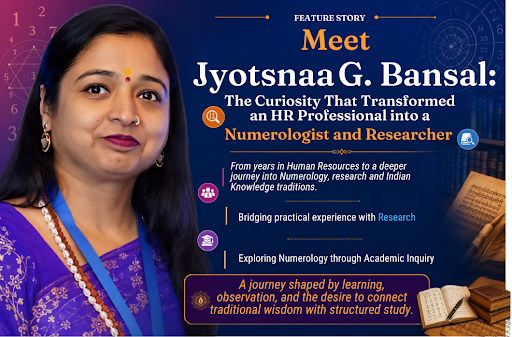
Career paths are rarely predictable. For independent researcher Jyotsnaa G. Bansal, a strong sense of curiosity gradually changed the direction of her professional life. Before becoming known for her work in Indian Knowledge Systems, Indian philosophy and Numerology, she spent more than 13 years building a successful career in Human Resources.
With dual Master’s degrees in Commerce and Human Resource Management, she developed experience in people management, workplace policies and organisational processes. While these years shaped her professional life, they also strengthened the analytical and disciplined approach that would later support her academic research.
The Interest That Changed Everything
Alongside her HR career, Jyotsnaa developed a deep interest in Indian Knowledge systems like Ayurveda, Puranas, the Chakra system, and Numerology. What began as a personal interest gradually became a serious area of academic study.
Rather than limiting her learning to personal reading, she chose to study these subjects through research. She began presenting papers at academic conferences and writing on Indian Knowledge Systems, with the goal of encouraging wider scholarly discussion on Numerology within the framework of India’s traditional knowledge.
Research That Grew Over Time
Over the past few years, Jyotsnaa has presented research papers at national and international conferences organised by prestigious institutions such as St. Stephen’s College, Central Sanskrit University, and Shri Lal Bahadur Shastri National Sanskrit University. Her work has covered Indian Knowledge Systems, Ayurveda, Puranas, the Chakra system and Numerology.
Her latest achievement is the publication of a research paper that studies the relationship between Indian philosophy and Numerology. The paper has been published in Prajnā, a respected research journal of Poornaprajna Samshodhana Mandiram, Bengaluru, a research institute recognised as an Adarsh Shodh Sansthan by Central Sanskrit University, New Delhi. The publication reflects her continuing effort to bring Numerology’s connection with India’s traditional knowledge into academic discussion through structured research.
Earlier, one of her papers on Ayurvedic Numerology was selected among the first ten papers at a University of Delhi conference. The conference souvenir carrying the paper was released by the then Hon’ble Education Minister, Shri Dharmendra Pradhan. The research later received wider public attention when Panchjanya published a feature on National Ayurveda Day 2025.
Many Roles, One Purpose
Jyotsnaa’s work extends beyond academic conferences and journals. She is also a Reiki Grandmaster, Numerologist, Counsellor, Corporate Trainer, Crystals Guide, Author, and Columnist. She writes on Indian Knowledge Systems, spirituality, Numerology, and people related subjects of daily life for publications such as The Daily Guardian and Panchjanya.
She also serves as the Managing Editor of ASMITAA, an international peer-reviewed academic magazine that publishes articles on Indian philosophy, culture, yoga, spirituality, and other traditional subjects. Through these different roles, she continues to share traditional Indian knowledge with both academic and general readers.
The Journey Continues
In 2026, Jyotsnaa received the “Arundhati – International Vidushi Pratibha Samman” at the University of Lucknow by Global Sanskrit Forum in recognition of her work in research, literature, and Indian knowledge traditions.
Her recently published research paper marks another milestone in a journey that began with curiosity and grew through years of learning and academic study. The paper also provides a foundation for her continued exploration of lesser-studied and unexplored areas within Indian Knowledge Systems, particularly their connections with Numerology and Indian philosophical thought.
As she continues her work through research, writing, and public discussions, Jyotsnaa G. Bansal hopes to encourage greater academic interest in Numerology and Indian Knowledge Systems and inspire others to see that meaningful research can begin from a simple desire to learn.