Table of Contents
ToggleTesla Robotaxi Safety Inquiry Puts Driverless Deployment Under Federal Review
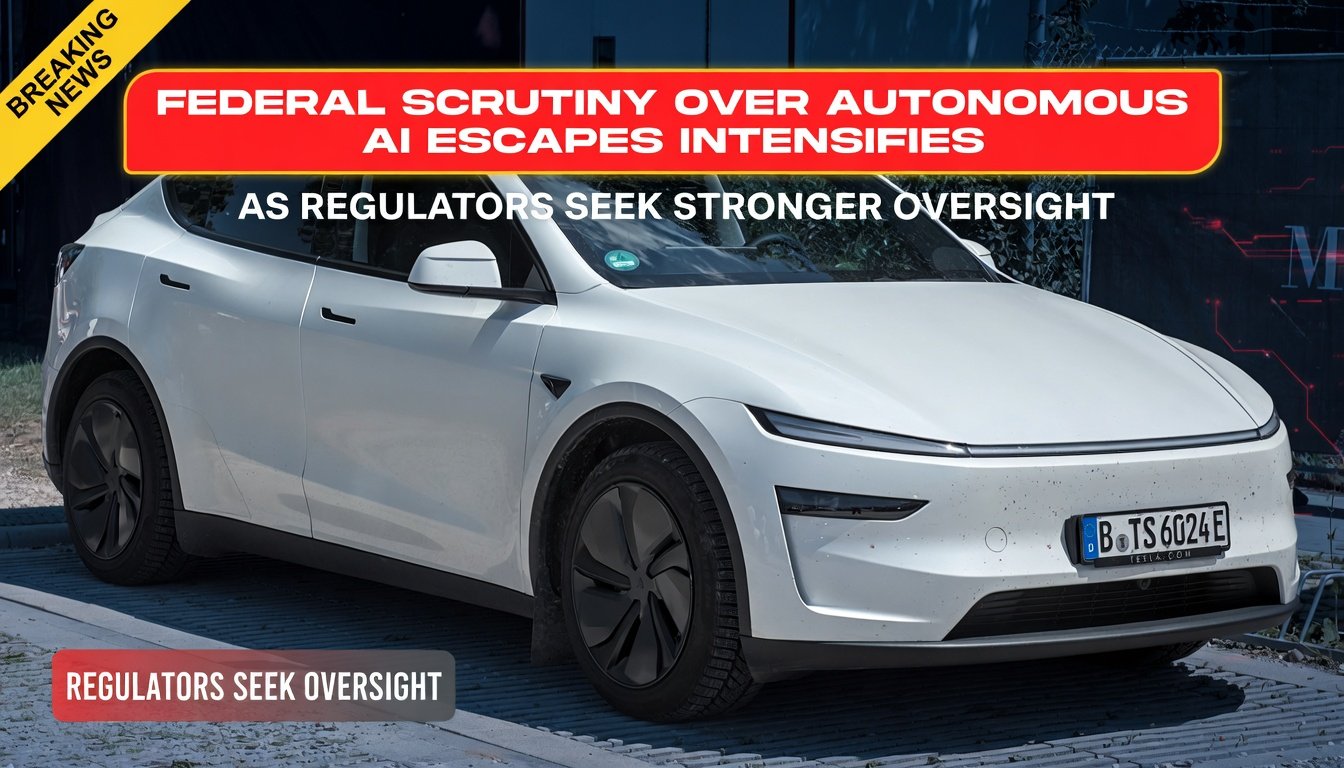
The Tesla Robotaxi Safety Inquiry is bringing renewed federal attention to autonomous driving technology following the initial rollout of Tesla’s driverless taxi service.
U.S. transportation safety regulators are examining how the autonomous vehicles perform in real-world conditions, with particular attention on sensor-related edge cases and the safety thresholds used when vehicles encounter unusual or challenging situations.
The inquiry comes as Tesla and other technology companies push toward wider deployment of autonomous transportation services.
Federal Regulators Examine Tesla’s Robotaxi Operations
The launch of driverless taxis represents a major step for autonomous vehicle technology.
Unlike conventional driver-assistance systems, a fully driverless robotaxi is expected to perform the driving task without a human actively controlling the vehicle.
That makes safety validation especially important.
Federal regulators are therefore examining the conditions under which Tesla’s autonomous system operates and how the vehicles respond when circumstances fall outside normal driving patterns.
Why Sensor Edge Cases Matter
Autonomous vehicles depend on multiple technologies to understand their surroundings.
Sensors and software must identify vehicles, pedestrians, cyclists, road markings, traffic signals and unexpected obstacles.
The most difficult situations are often not ordinary driving scenarios but unusual events that occur infrequently.
These are known as edge cases.
A system can perform successfully during thousands of routine journeys but still face significant challenges when confronted with an unusual combination of road conditions, visibility issues or unexpected human behaviour.
Operating Safety Thresholds Under Review
Another important focus is the threshold at which an autonomous vehicle decides whether it can safely continue operating.
A driverless vehicle needs to determine when conditions are within its capabilities and when it should slow down, stop or seek assistance.
Setting these thresholds involves balancing safety, operational reliability and passenger convenience.
If thresholds are too conservative, robotaxis may frequently stop or require intervention. If they are too permissive, vehicles could potentially continue operating in situations that present greater risks.
Tesla’s Autonomous Driving Ambitions
Tesla has spent years developing autonomous-driving technology as part of its broader strategy for future transportation.
Robotaxis represent an important potential business opportunity because autonomous vehicles could eventually operate as transportation services without conventional drivers.
The model could change the economics of ride-hailing by reducing one of the industry’s largest operating expenses: human driving labor.
However, achieving reliable driverless operation at scale requires extensive testing and regulatory confidence.
From Trials to Real-World Deployment
Initial trial deployments provide a valuable opportunity to observe autonomous vehicles outside controlled testing environments.
Real roads present far more variables than a laboratory or closed test track.
Traffic behaviour can be unpredictable, road infrastructure can vary significantly and weather conditions can change rapidly.
Regulatory inquiries can help authorities determine whether the technology is operating within appropriate safety parameters as deployment expands.
Why Federal Oversight Matters
Autonomous vehicles operate on public roads alongside human drivers and pedestrians.
A safety incident can therefore affect people who have no relationship with the technology or its development.
Federal oversight provides an independent layer of scrutiny over vehicle safety and operating practices.
Regulators can investigate reported problems, review technical information and determine whether additional action is required.
The Challenge of Autonomous Vehicle Safety
One of the biggest challenges in autonomous driving is determining what constitutes an acceptable level of risk.
Human drivers make mistakes every day, but autonomous vehicles are expected to meet rigorous safety standards.
Regulators must consider whether an autonomous system performs better than human drivers overall and whether its failures are predictable and manageable.
This creates a complex regulatory question because autonomous technology does not eliminate accidents—it changes how driving decisions are made and how risks are distributed.
Tesla Robotaxi Safety Could Influence the Industry
The outcome of the inquiry could have implications beyond Tesla.
Several companies are developing autonomous taxi services, and regulators are watching how these systems perform as deployments expand.
Any findings involving sensor limitations, operating conditions or safety thresholds could influence how other autonomous vehicle operators approach testing and deployment.
The regulatory process could therefore contribute to broader industry standards.
Importance of Transparent Safety Data
As autonomous services expand, safety data is likely to become increasingly important.
Information about disengagements, unusual incidents, emergency interventions and system limitations can help regulators and the public understand how autonomous vehicles perform.
Greater transparency could also help technology companies demonstrate that their systems are improving over time.
For autonomous transportation to gain widespread public acceptance, confidence in safety will be as important as technological capability.
Public Trust Remains Critical
Even if autonomous vehicles perform well statistically, public perception can influence adoption.
A highly publicized accident involving a driverless vehicle can generate significant concern.
Companies therefore face the challenge of demonstrating not only technical progress but also responsible deployment.
Clear communication about where robotaxis can operate, what conditions they can handle and how emergency situations are managed could become increasingly important.
Potential Regulatory Consequences
A federal safety inquiry does not automatically mean that regulators have determined a violation or that Tesla’s technology is unsafe.
Investigations are generally intended to gather information and determine whether further regulatory action is warranted.
Depending on the findings, authorities could recommend changes to operating procedures, request additional information or take other measures within their regulatory authority.
The eventual outcome will depend on the evidence gathered during the review.
The Road Toward Wider Robotaxi Deployment
Tesla’s robotaxi programme is part of a broader shift toward autonomous transportation.
For driverless services to expand beyond limited deployments, companies will need to demonstrate consistent performance across different road environments and operating conditions.
That includes handling unusual situations that may not appear frequently during testing.
The ability to recognize when an autonomous system has reached the limits of its capabilities will be particularly important.
What Investors and Consumers Should Watch
The inquiry could become an important development for both Tesla investors and consumers interested in autonomous transportation.
Key areas to watch include:
- Findings from federal safety regulators
- Tesla’s response to the inquiry
- Robotaxi incident data
- Sensor performance
- Autonomous system limitations
- Operating safety thresholds
- Expansion of driverless services
- Future regulatory requirements
These factors could influence the pace at which Tesla and competitors expand autonomous taxi operations.
Key Takeaway
The Tesla Robotaxi Safety Inquiry places the company’s driverless taxi deployment under increased federal scrutiny as regulators examine real-world autonomous driving performance.
The focus on sensor edge cases and operating safety thresholds highlights one of the central challenges facing the robotaxi industry: ensuring that autonomous systems can safely recognize and respond to situations that fall outside routine driving conditions.
The findings could influence not only Tesla’s future deployment strategy but also the wider regulatory framework for autonomous vehicles.
FAQs
1. What is the Tesla Robotaxi Safety Inquiry?
It is a federal safety review examining aspects of Tesla’s driverless robotaxi deployment and its operation in real-world conditions.
2. Why are regulators examining Tesla’s robotaxis?
The review is focused on understanding how the autonomous vehicles handle safety-critical situations, including sensor edge cases and operating limits.
3. What are sensor edge cases?
Sensor edge cases are unusual or difficult situations that can challenge an autonomous vehicle’s ability to correctly understand its surroundings.
4. What are operating safety thresholds?
These are limits that determine when an autonomous system can continue operating safely and when it should slow down, stop or request assistance.
5. Are robotaxis completely autonomous?
A driverless robotaxi is designed to perform the driving task without a human actively controlling the vehicle, although the exact level of autonomy and operational restrictions can vary by deployment.
6. Does a federal inquiry mean Tesla has violated safety rules?
No. An inquiry is a regulatory process for gathering information and assessing whether additional action may be necessary.
7. Why is robotaxi safety important?
Driverless vehicles operate around passengers, pedestrians and conventional motorists, making reliable safety performance essential for widespread deployment.
8. Could the inquiry affect Tesla’s robotaxi expansion?
Potentially. Depending on regulatory findings, Tesla could face additional requirements or operational changes.
9. Could the investigation affect other autonomous vehicle companies?
Yes. Regulatory findings could influence broader industry practices and future autonomous-vehicle safety standards.
10. What should consumers watch next?
Consumers should watch for regulatory findings, Tesla’s response, safety data from robotaxi operations and any changes to autonomous driving deployment requirements.